

Face Reading in the Classroom – Understanding Students Better

Aktualisiert: 5. März
Why Face Reading Can Be a New Tool for Teachers
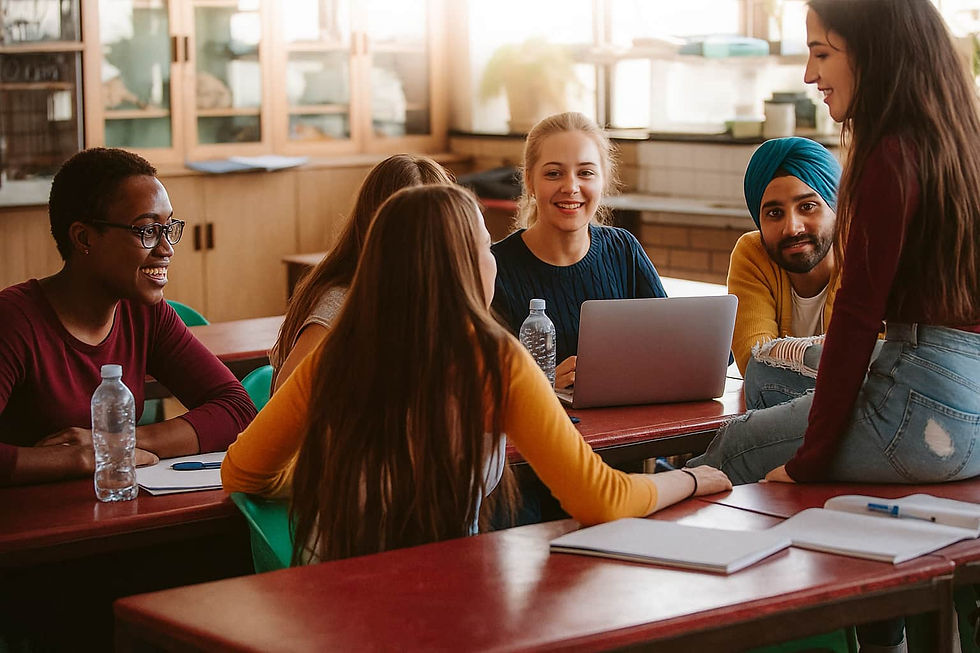
It often takes only seconds in the classroom or in a conversation with students to form a first impression. We sense: something isn’t right. Or we notice that someone seems insecure, tense, or overwhelmed – without the student having said a single word. What is Face Reading?
But what exactly are we perceiving in those moments? And how consciously do we make use of this perception? This is precisely where Face Reading comes in: as a complement to pedagogical knowledge, not as a replacement.
Table of Contents
The Challenge in the Education System
Teachers today face challenges that go far beyond the transmission of knowledge:
Heterogeneous classes with diverse social backgrounds
Inclusion of children with special educational needs
Increasing pressure from digitalization, assessments, and performance demands
Conflicts in the classroom that require empathy and sensitivity
Many teachers report: “I can tell that something is going on, but I don’t know how to interpret it.”
It is precisely in this gray area that uncertainty, misunderstandings, and sometimes even escalation arise.
Face Reading: Not Magic, but Trained Perception
Face Reading is the art of deriving personality traits, emotional patterns, and inner needs from the visible signals in the face. It is not about putting students into boxes but about perceiving more precisely what is already visible:
Protective mechanisms: Recognize when a child shuts down outwardly while actually feeling overwhelmed inside.
Emotional tensions: Detect signs of stress, sensitivity to stimuli, or inner conflicts.
Communication style: Some children react directly and impulsively, while others withdraw. This is reflected not only in their behavior but also in their expression.
A trained eye can help interpret nonverbal signals instead of just sensing them vaguely.
Practical Application: Where Teachers Benefit
1. Conducting parent-teacher meetings with greater clarity
When parents appear defensive or overly cautious, teachers can use facial expressions to better understand the underlying attitude and adjust their communication accordingly.
2. Defusing conflicts in the classroom
Does a student seem disrespectful, or are they simply overstimulated? Face Reading helps to recognize these differences and avoid misunderstandings.
3. Recognizing talents and potential early on
A face does not only reveal protective mechanisms but also inherent traits: creativity, sense of order, assertiveness. These are valuable cues for educational support.
Checklist: 3 Questions for Your Next School Day
Does the facial expression match what the child is saying?
Do I see tension, insecurity, or resignation that is not being put into words?
What stance do I take myself—do I resonate or create distance?
These questions can help teachers perceive interactions more consciously and respond more effectively.
Mini Case Study
A teacher shares:
“After attending the specialist training, I began to notice facial cues in the classroom more consciously. One student, in particular, stood out to me. Every time I called on her, she would subtly pull her lips inward. A small, almost imperceptible movement. In the past, I probably wouldn’t have noticed it at all.
During the training, I had learned that this kind of lip compression is often a self-soothing gesture – a way for the body to regulate emotions and cope with inner stress.
For the first time, I found the courage to gently address what I had observed:
‘I get the sense that something unsettles you when I speak to you.’
What followed really surprised me. The student didn’t say she was afraid of not knowing the answer. Instead, she told me that it triggered anxiety every time I pointed at her when calling her name – something I actually did quite often. I had never thought twice about it.
That’s when I realized: the issue wasn’t her knowledge, but an unconscious trigger in our interaction. I consciously changed my behavior and stopped pointing altogether. That changed everything. She gradually opened up – and the lip compression completely disappeared.”
This is exactly where the impact shows: a shift in perspective that transforms the relationship.
Conclusion: See More, Act with Clarity
Face Reading can support teachers in consciously noticing and better interpreting the subtle signals of their students.
Not to judge too quickly.
But to understand more deeply.
Because: it’s not only children who show us more than they can often put into words. Those who learn to read these signals can not only guide students better academically but also meet them more fairly on a human level.
➡️ In the specialized training “Understanding Students Better – Face Reading for Teachers” I show you how to sharpen your perception and apply it in everyday teaching.
If you would like to dive deeper into Face Reading
If you’re curious how Face Reading developed over time and why responsibility has always been part of it, this article offers a reflective historical perspective.
If small details in the lower face draw your attention, this article explores how inner tension and self-expression can subtly appear there.
If you want to understand how endurance, responsibility, and lived experience can shape the face, this article takes a calm and thoughtful look.
If you’re interested in different traditions of reading the face and where clear distinctions matter, this article provides orientation and context.
If you want to see how empathic perception supports leadership, communication, and decision-making, this article shows Face Reading in a professional setting.
Free Face Reading Webinar – live every month
In my monthly live webinar, I show you how Face Reading works in practice.
You will learn how facial features are connected to personality, resources, and inner patterns – and how you can use this knowledge for coaching, communication, or your personal development.
The webinar is designed to be interactive and offers plenty of space for your questions.
Join for free here: