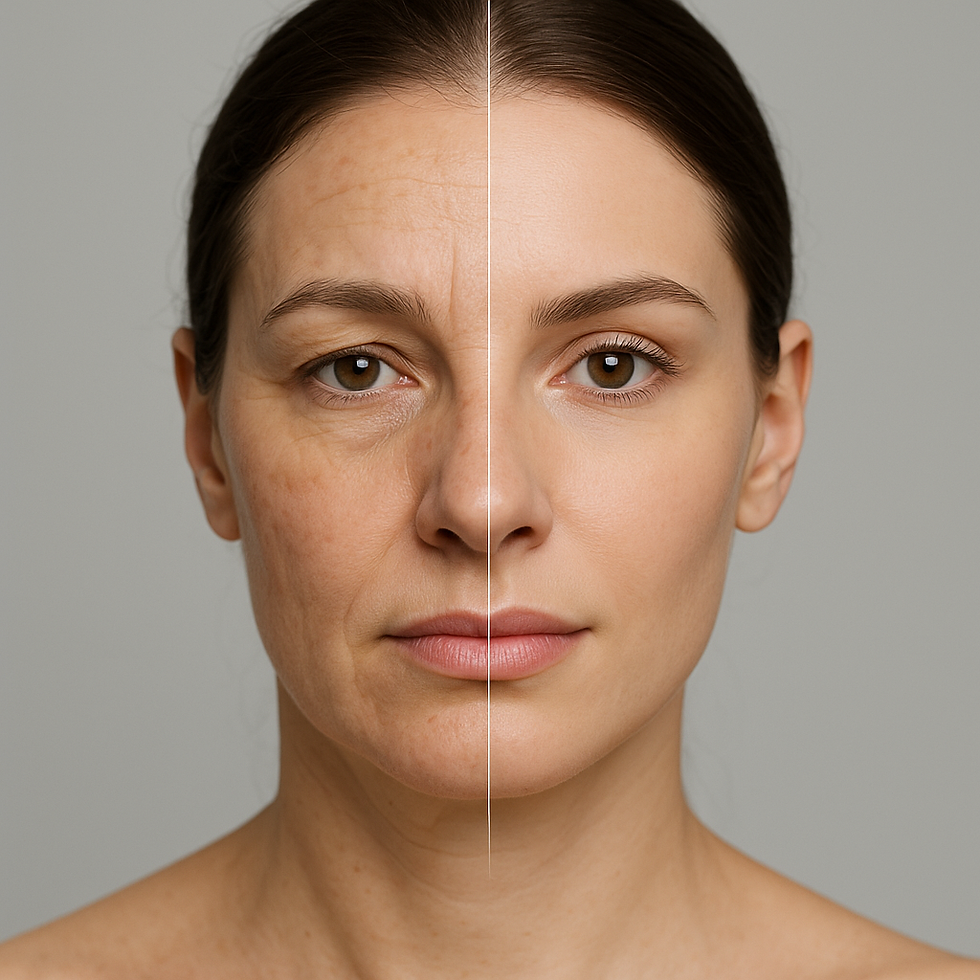
Frown lines or worry lines?

Updated: Mar 5
Why this small line reveals much more than just anger
Most people know them as frown lines: the vertical lines between the eyebrows, directly above the bridge of the nose. In medicine, they are referred to as glabellar lines, and in physiognomy as steep lines.

In everyday life, we associate them with anger, severity, or a “grim” facial expression. But when you take a closer look at how this line actually forms, it quickly becomes clear:
Frown lines are much more than a sign of anger. In many cases, they are worry lines – traces of inner pressure, intense thinking, responsibility, and suppressed emotions.
In this article, we take a closer look at:
how frown lines form through facial expression
what they reveal in Face Reading about worrying, anger, and self-criticism
why persistent worrying can promote depression and exhaustion
and how you can find a healthier way of dealing with this inner tension
Contents at a glance
1. What frown lines really are from a facial‑expression perspective
The vertical frown lines are created through repeated activity of specific facial muscles:
corrugator supercilii muscle (the eyebrow frowner)
procerus muscle
depressor supercilii muscle
When we draw our eyebrows together, the following happens:
the eyebrows move inward and slightly downward
the skin between the eyebrows is compressed
vertical lines form on the glabella
This movement appears in different emotional contexts:
“cold” anger: irritation, skepticism, quiet resistance
“hot” anger: especially when the upper eyelids are raised at the same time
confusion and doubt: “Something doesn’t feel right here”
intense concentration: cognitive strain, mental tunnel vision
pain or physical exertion
What’s fascinating: studies show that simply drawing the eyebrows together is enough to activate the amygdala – our emotional alarm center. The stronger the contraction, the stronger the reaction of the limbic system. Our facial expression feeds our emotions back into the brain (facial feedback).
The Facial Feedback Hypothesis – Why Facial Expressions Intensify Emotions
The so-called Facial Feedback Hypothesis proposes that our facial expressions are not merely reflections of internal states, but actively influence them as well. Studies show that consciously tensing or relaxing specific facial muscles can have measurable effects on emotional experience (Strack, Martin & Stepper, 1988)
Link to the study: (Strack, Martin & Stepper, 1988) Inhibiting and facilitating conditions of the human smile: A nonobtrusive test of the facial feedback hypothesis.
Neuroscientific research further demonstrates that facial muscle activity is associated with activation patterns in the amygdala and the prefrontal cortex. In other words, our face genuinely influences how we process emotions.
In other words:
Frown lines are not a coincidence. They form when a person repeatedly lives for many years in states of tension – mentally, emotionally, or situationally.
2. Vertical frown lines in Face Reading – anger, worrying, and mental pressure
In Face Reading, the vertical lines between the eyebrows are referred to as steep lines. They run from the bridge of the nose upward toward the forehead and hairline. Sometimes they also originate from the inner base of the eyebrows.
What they generally indicate
worrying and critical thinking
inner tension – emotional or mental
impatience, irritability, frustration, or anger
a tendency toward tunnel vision: getting mentally stuck on problems
a tendency to demand a great deal from oneself
Many traditional texts speak of “thinking lines,” “worry lines,” “discontent lines,” or “frown lines.” What they all have in common is the same idea:
Here, someone has lived with tense thoughts or emotions for a long period of time.
In the area between the eyebrows lies, according to Chinese medicine, the liver zone. This area reflects how we deal with anger, frustration, impatience, and inner pressure. Wrinkles and color changes here show how much anger and tension have accumulated over the course of life – and whether they have been resolved or have remained “stuck.”
The area between the forehead and the mouth forms an interconnected field. While frown lines reflect mental tension, the meaning of the philtrum in Face Reading reveals more about emotional impulse regulation and relationship dynamics.
3. One line or two?
Single steep line (“hanging needle”) vs. two parallel worry lines
In Face Reading, a distinction is made between:
a single, central vertical line – the so‑called “hanging needle,” “hanging dagger,” or “hanging sword,” depending on its form.
two parallel lines – the classic appearance of frown lines
Both variants carry their own distinct message.
3.1 The single steep line – “Suspended Needle” (Mian Xiang 悬针纹)

A single, deep, vertical line exactly in the center between the eyebrows is considered one of the most striking signs in the face.
In classical Chinese Face Reading (Mian Xiang 面相), this line is traditionally called the “Suspended Needle”:
Chinese term: 悬针纹 (traditional: 懸針紋)
Literal meaning: “hanging / suspended needle line”
Classical English term (traditional literature): Suspended Needle
This term has been used for centuries in Chinese physiognomy and appears consistently in older English-language Mian Xiang sources.
When lived in a constructive way, this line stands for:
enormous determination and endurance
strong self-discipline and focus
people who “pull the cart out of the mud” when things get difficult
a high sense of responsibility and the need to see things through to the end
the ability to work through adversity by sheer willpower
Many people who carry a Suspended Needle achieve a great deal – not because things come easily to them, but because they persist through inner strength and resolve.
When lived in a destructive way, the same line can indicate:
suppressed anger that has no healthy outlet
stubbornness, self-righteousness, “I will push this through at all costs”
a tendency toward self-sacrifice and harshness toward oneself
fanaticism: clinging to goals or beliefs even when they are no longer healthy
difficulty admitting mistakes or correcting one’s own course
In Chinese medicine, this line is described as a sign of a blockage in the life flow: there is a great deal of energy present (Liver Qi), but it cannot flow freely. Old, unresolved issues or suppressed anger can act like “islands in a river,” slowing the current.
3.2 Parallel steep lines – worry lines and thinking lines
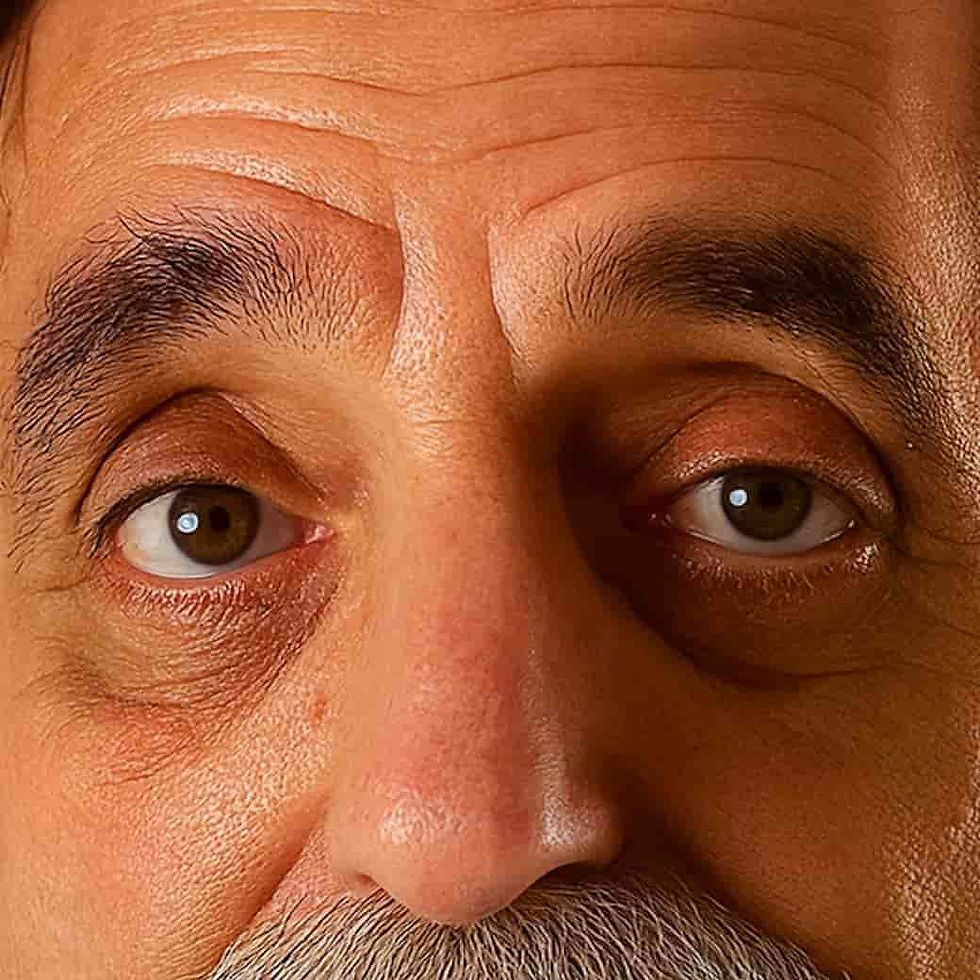
Two vertical lines between the eyebrows tell a slightly different story.
They stand for:
intense worrying – often over many years
a tendency toward critical thinking and constant weighing of options
strong mental discipline – the mind always switched “on”
people who demand far more of themselves than they would ever demand of others
anger that is released in portions: small outbursts, irritated reactions, inner restlessness
Emotionally, the following themes often appear here:
impatience
irritability
frustration
anger toward oneself or others
You can imagine people with pronounced worry lines like someone who never fully shifts into neutral internally. The mind keeps working, evaluating, controlling, judging. This can bring great clarity and decisiveness – but also self-doubt and exhaustion when the focus constantly rests on what is still not good enough.
Terminology clarification (important for understanding):
Glabellar lines – the standard medical term for vertical lines between the eyebrows
Frown lines – the most common everyday / colloquial term
“11 lines” – a beauty-industry slang term for two parallel vertical lines
All three terms refer to the same facial area, but come from different contexts: medicine, everyday language, and aesthetics. In Face Reading, we look beyond the name and focus on the inner patterns that have shaped these lines over time.
4. Left or right – what is this person worrying about?
In Face Reading, side dominance also plays an important role:
left steep line more pronounced:
n - stronger stress related to emotional and relationship themes
emotional wounds, heartbreak, family dynamics
love relationships weigh more heavily than career or status
right steep line more pronounced:
n - greater strain from material issues, work, and external responsibility
worrying about performance, security, finances, social role
stronger focus on “functioning” outwardly
If one side is clearly more pronounced, it can be assumed that this area of life has particularly challenged or stressedthe person.
5. Why worrying harms the psyche and what studies show
Chronic worrying is considered in psychology to be one of the most important risk factors for depressive mood and stress. Thoughts keep circling without truly producing new solutions. The nervous system remains on alert, and the body no longer enters recovery.
The good news: emotional regulation can be trained. A large meta-analysis by Sakiris & Berle (2019) shows that training programs for emotion regulation reduce anxiety and depressive symptoms, increase the use of healthy strategies (such as cognitive reappraisal and mindfulness), and reduce unproductive rumination. Overall, people report a higher quality of life.
Similar results apply to acceptance-based strategies. A meta-analysis by Kohl, Rief & Glombiewski (2012) concludes that inner acceptance – allowing feelings to be present instead of suppressing them – is particularly helpful when a situation cannot be controlled. The burden decreases, and psychological flexibility increases.
For me, this means: frown lines or worry lines tell a story about how you have dealt with pressure and emotions so far. But they do not determine how you must treat yourself in the future. The better you learn to regulate and accept emotions, the less you need to run your life “with your forehead.”
In 2026, the Neuhaus Face Reading Institute will launch a pilot study with approximately 100 participants in cooperation with psychological test diagnostics.
Among other aspects, the study will examine the extent to which persistent facial muscle activity, personality traits (Big Five), and perceived emotion regulation are related.
The goal is to make Face Reading systematically open to scientific verification.
6. Frown lines, anger, and liver energy – the view of Chinese medicine
In Traditional Chinese Medicine (TCM), the area between the eyebrows is closely connected to liver energy.
This area reflects:
anger, rage, frustration
the ability to assert oneself in a healthy way
but also depletion of liver energy through chronic stress, alcohol, and overload
Some signals observed here include:
reddening: current anger, “inflamed” liver energy
dark indentation: exhaustion, depression, feeling of helplessness
greenish tone: toxic, long-suppressed anger
very pale area: emotional freeze, difficulty feeling or expressing anger at all
What is important:
These indications are not medical diagnoses, but observational cues that are placed into a larger context in Face Reading. If physical symptoms are present, this always belongs in the hands of doctors and therapists.
7. What frown lines are not – and why “just removing them” is not enough
In our culture, frown lines are often seen as a purely aesthetic problem:
“You look strict.”
“You seem older than you are.”
“Botox softens the look.”
There is nothing wrong with aesthetic treatments if they feel right for someone. What matters is this:
The line itself is not the problem, but the trace of an inner pattern.
If the pattern – such as:
chronic worrying
suppressed anger
excessive perfectionism
harshness toward oneself
… remains untouched, little changes internally, even if the line is smoothed out. In some cases, it can even feel paradoxical when the face appears calm while the same pressure continues working inside.
Similar to the nasolabial fold in Face Reading, this area also illustrates how inner patterns of tension can become structurally embedded in the tissue over the years.
At this point, a bridge opens between cosmetic surgery and Face Reading:
Aesthetic procedures can be meaningful – but they gain a new depth when the following question is also asked:
“What inside me wrote this line – and how do I want to treat myself in the future?”
If you are interested in how Face Reading complements aesthetic medicine, what psychological effects facial changes can have, and why a holistic view is so valuable for clinics, practices, and patients, you will find a more in-depth article here:
→ Face Reading and cosmetic surgery: psychological impact and new perspectives for doctors and clinics
8. Treating Frown Lines with Botox – What Really Changes?
From a dermatological standpoint, glabellar lines primarily develop due to repeated activation of the corrugator supercilii muscle combined with age-related loss of skin elasticity. In aesthetic dermatology, they are therefore commonly treated with botulinum toxin to temporarily reduce muscle activity.
Professional organizations such as the American Academy of Dermatology (aad) classify glabellar lines as classic dynamic wrinkles of the upper third of the face.
Studies show that reducing muscle activity in the glabellar region does not only change appearance, but in some cases may also influence depressive symptoms — once again highlighting the close connection between facial expression and emotion.
From a Face Reading perspective, one question remains:Is only the surface changing — or is the inner way of dealing with pressure and self-criticism shifting as well?
9. Living with frown lines in a constructive way – instead of against yourself
In Face Reading, there is no stamp of “good” or “bad.” It is about whether we live a feature constructively or destructively.
Lived constructively, frown lines stand for:
consciously using your ability for focus, discipline, and responsibility
expressing anger and boundaries clearly, but not destructively
learning to regulate inner tension instead of only suppressing it
becoming kinder and gentler toward yourself
occasionally relaxing the forehead, exhaling, and widening your gaze
Lived destructively would be:
getting stuck in rumination loops for years
permanently overburdening yourself
swallowing anger until it discharges as cynicism, sarcasm, or explosive outbursts
seeing any softness as weakness
So when you see your own frown lines in the mirror, you can also read them as an invitation:
“Where am I too hard on myself? Where do I take everything too personally?
And where would it be time to give my face more calm, clarity, and kindness again?”
10. When frown lines become worry lines – a different way of looking at your face
For me, it feels more accurate to call these lines not only frown lines, but to understand them as worry lines:
as traces of responsibility you have carried
as signs of inner vigilance that got you through difficult times
as reminders of how often you tried to do everything right
In Face Reading, the goal is not to judge these traces.
It is to understand them and ask yourself how you want to treat yourself in the future.
Your face is not a criminal record, but a diary of your inner efforts.
And every feature – including frown lines – can become a turning point when you begin to take its message seriously.
Would you like to learn more about Face Reading?
If you would like to dive deeper into Face Reading, you have two different options:
Experience Face Reading
Would you like to know what your face, with all its individual features, reveals about you?
In a personal Face Reading session, we explore your personality and your talents in depth, helping you understand yourself better and shape your life with greater clarity and confidence.
Learn Face Reading
Would you like to understand not only yourself, but also other people on a deeper level? In the Foundation Training, you learn the fundamentals of Face Reading and afterwards you will be able to assess yourself and others accurately and with empathy.
Further Articles
Tear bags can point to uncried tears, inner blockages, and weakened kidney energy. Here you will learn what they mean – far beyond mere appearance.
Under the eyes, what we have carried inside for a long time often becomes visible. In this article, you will learn how Face Reading interprets this area, which emotions are reflected there, and what role fear, grief, and cortisol really play.
The so-called strawberry chin shows far more than a skin irregularity. It tells a story of how a person deals with fear, pressure, and inner tension, and which life experiences have shaped the nervous system over the years. If you want to understand why the chin in particular reveals so much about basic trust, inner strength, and the ability to let go, you will find a deeper article here.
If you are interested in how wrinkles become traces of lived experience, this article takes you deeper.
You will learn which types of wrinkles exist, why they form, and what their shape, depth, and position reveal about emotions, life patterns, and personality.
A perspective that shows you: wrinkles are not “flaws,” but expressions of your story.
If you want to understand how differently people live closeness and how much can be recognized from lip shape alone, you will find clear orientation here. Each shape tells a different story about emotional openness and communication style.
FAQ about frown lines (worry lines / thinking lines)
1. What do frown lines really reveal about a person?
Frown lines rarely stand for “anger” alone. In facial psychology and Face Reading, they often point to concentrated thinking, inner tension, unresolved issues, or high mental load. Whether a line is more closely linked to emotions, work, responsibility, or vulnerability is revealed by its shape and position.
2. Can you tell from the side of the line whether someone is emotionally or professionally stressed?
Yes.
Left side more pronounced: more emotional or personal themes, often an indication of inner rumination.
Right side more pronounced: more professional, material, or external demands.
Both sides clearly visible: strong mental pressure, perfectionism, or very high self-demands.
These observations do not replace diagnoses, but they do show typical patterns.
3. Do frown lines always mean anger?
No. Focus, concentration, skepticism, reflection, and mental discipline can trigger the same muscle movement.
The line is therefore less an “emotion-detection feature” and more a “life-tension marker” – a trace that shows where a person has invested a great deal of energy over time.
4. Can frown lines disappear again?
They can change, soften, or smooth out when the inner state changes – for example through relaxation, sleep, stress reduction, or emotional clarification.
Typical medical procedures such as Botox or hyaluronic acid work on the surface, but they do not change the underlying tension that originally formed the line.
5. What does a single deep steep line (“Suspended Needle”) mean?
A single, very pronounced line stands in Face Reading for:
iron will and strong goal orientation
self-discipline and focus
suppressed anger or restrained life energy
the tendency to achieve a great deal – but also to carry a great deal
When lived constructively, it can release enormous strength. When lived destructively, it can lead to rigidity or exhaustion.
6. What do two parallel frown lines mean?
Two evenly formed lines often point to people who:
think intensely
weigh options constantly
have very high demands on themselves
tend toward overload
find it difficult to let go of emotional or professional issues
In Face Reading, they are also called worry lines, because they show that someone works a great deal “in the head.”
7. Do frown lines really form through worrying?
Yes – many studies show that sustained concentration, tense thinking, and negative thought loops increase muscle activity around the eyebrows.
Over time, this expression becomes etched into the face (“facial feedback”).
The body, so to speak, records what has been emotionally or mentally moving.
8. What helps with chronic worrying?
Worrying cannot simply be pushed away – but it can be redirected.
Proven approaches include:
emotion regulation and breathing exercises
acceptance- and mindfulness-based strategies
small physical movements
changing focus and perspective work
These techniques reduce inner pressure – and, over time, also the muscle tension that deepens lines.
9. Do frown lines have something to do with personality?
Yes – but not in the sense of a fixed “character trait.”
The line reflects lived practice: how someone thinks, reacts, what occupies them, and which patterns they unconsciously use.
It is less a “type” and more a biographical echo.
10. Can frown lines in Face Reading really provide insight into a person’s life?
In Face Reading, they are considered indicators of thinking style, emotional processing, and stress patterns.
They show:
what someone has thought about for a long time
which themes have created pressure
where inner energy has been blocked or held back
They are not predictions, but orientation points that help to understand people more deeply.